The Effort Paradox: Why Your Best Work Happens When You Stop Trying to Be Perfect
In 2026, we are trapped by the Effort Paradox: the harder you "white-knuckle" a result, the further it slips away. While everyone else is paralyzed by overthinking, the winners are those embracing the mess. The secret? Action is a search function. You don't get clarity before you start; you get clarity because you started. Stop waiting for 100%. Aim for 70% and just keep moving.
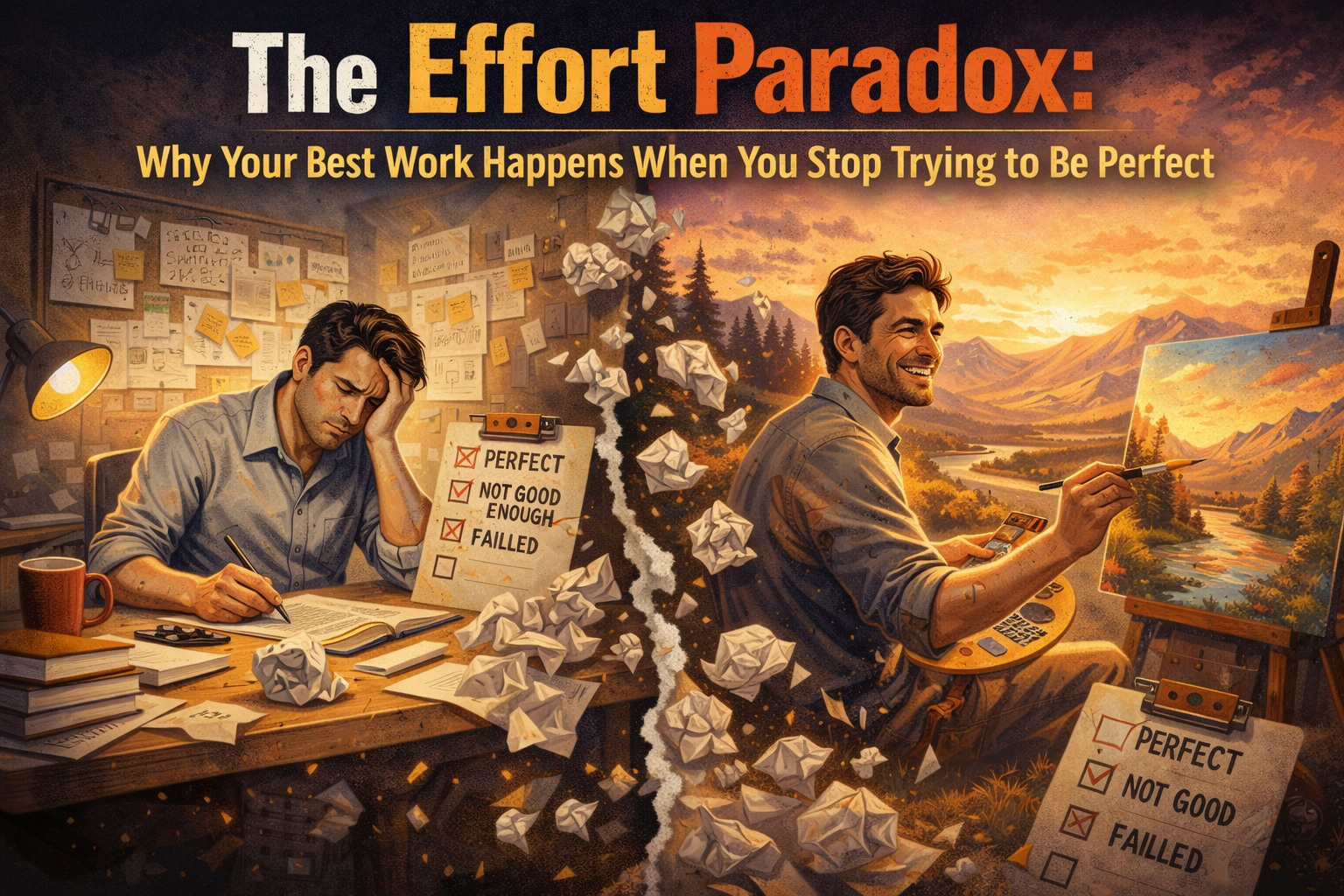
The Effort Paradox: Why Your Best Work Happens When You Stop Trying to Be Perfect
Introduction
In the high-pressure landscape of 2026, we are surrounded by "optimization culture." We have apps to track our sleep, AI to rewrite our emails, and algorithms that tell us exactly how to maximize every second of our day. We have been conditioned to believe that if we aren’t operating at 100% efficiency, we are failing.
But this has created a psychological bottleneck known as The Effort Paradox. The paradox is simple yet frustrating: The harder you try to force a perfect outcome, the more likely you are to stifle the very creativity and flow required to achieve it. By obsessing over the finish line, we trip over our own feet at the starting block.
Part I: The Paralysis of Perfection
Perfectionism is often worn as a badge of honor, but in reality, it is a sophisticated form of procrastination. It is a defensive mechanism designed to protect us from the pain of being judged. If we never finish the project, it can never be "bad."
In 2026, the stakes feel higher because synthetic media can produce "flawless" work instantly. This makes us feel like our human output needs to be even more perfect to compete. However, this mindset leads to Decision Fatigue. When every detail feels like a life-or-death choice, the brain eventually shuts down to protect itself. This is why you find yourself staring at a blank screen for three hours instead of writing for thirty minutes.
Part II: The Law of Reversed Effort
The philosopher Alan Watts often spoke about "The Law of Reversed Effort." He compared it to staying afloat in water: if you panic and try to scramble to the surface, you sink. But if you relax and trust the water, you float.
The same applies to our best work. Think about your greatest breakthroughs. Did they happen when you were white knuckling your desk, teeth clenched in frustration? Or did they happen during a walk, in the shower, or while you were "just messing around" with a rough draft?
When you stop trying to be "Great," you give yourself permission to be Functional. And once you are functional, you can become Fluid.
Part III: The "70% Rule" for Sustainable Growth
To beat the Effort Paradox, you have to adopt a new operating system. In 2026, top performers are moving away from the "all-or-nothing" mentality and embracing the 70% Rule.
Quantity Over Quality (At First): To find the 1% of your work that is brilliant, you must be willing to produce 99% that is average. Perfectionism prevents the volume necessary for discovery.
The B+ Standard: Aim to complete tasks to a "B+" level. This lowers the psychological barrier to entry. Ironically, once you start working without the pressure of an "A+," your natural talent takes over, and you often end up producing A-level work anyway.
Lowering the Floor: Don't raise the ceiling of your goals; lower the floor. Instead of "I will work out for an hour," make the goal "I will put on my gym shoes." The hardest part of effort is the transition from rest to motion.
Part IV: Action as a Search Function
We often think we need "Clarity" before we act. We wait for the perfect vision, the perfect business plan, or the perfect opening line.
Clarity is a reward for action, not a prerequisite.
Think of action as a "Search Function." Every time you attempt something and "fail," you haven't actually failed; you’ve successfully mapped out a path that doesn't work. In the Effort Paradox, "bad" work is actually the fuel for "good" work. You cannot refine a blank page. You cannot edit a thought that stays in your head.
By lowering the stakes and focusing on the process rather than the product, you bypass the brain's fear center (the amygdala) and enter a "Flow State."
Part V: The Power of "Strategic Sloppiness"
In an age of AI, "perfect" is now a commodity. Machines are perfect. Humans are interesting because of their deviations.
Strategic Sloppiness is the act of intentionally letting the first draft be messy. It’s about focusing on the "soul" of the work rather than the "syntax." When you allow yourself to be sloppy, you tap into your subconscious. You make connections that a rigid, perfectionist mind would overlook because they seem "illogical."
This is why hand-drawn sketches often have more energy than 3D renders, and why live recordings often sound better than studio-perfected tracks. There is a "ghost in the machine" that only appears when you stop trying to control everything.
Conclusion: Reclaiming Your Creative Agency
The Effort Paradox teaches us that the path to excellence is paved with "good enough."
As we move further into 2026, the most valuable skill you can possess is the ability to start without a guarantee. While everyone else is waiting for the perfect conditions, the perfect tools, or the perfect amount of energy, you must be willing to be "clunky.
Success isn't about the absence of mistakes; it’s about the presence of momentum.
The Challenge:
Pick one thing you’ve been putting off because you’re afraid it won't be "right." Give yourself exactly 20 minutes to do it as poorly as possible. Throw out the rules, ignore the inner critic, and just move your hands.
You’ll find that once the pressure of being "Perfect" is removed, the "Best" version of you finally has room to show up.
Category: Personal Development / Psychology of Success
Tags: #Motivation2026 #ProductivityHacks #Perfectionism #GrowthMindset #TheEffortParadox
Comments (3)
Leave a comment
User
Jul 29, 2026
great article
User
Jul 29, 2026
Interesting 🔥
User
Jul 29, 2026
Knowledgeable
About the Author

Tell us a little about yourself.